
EMERGING TECH
-
AI-enabled, adaptive, and immersive training with measurable proficiency gains.
Our family of companies has deep and lengthy federal delivery history, spanning instructional systems design, courseware development, simulation-based instruction, aircrew and operator training, and performance assessment across defense customers. What ACE adds is the technology layer, and a specific view of where technology impactfully improves outcomes.
Three constraints limit military and federal training today. Content is slow and expensive to produce, which means it lags the threat. Instruction is largely uniform, which means fast learners wait and struggling learners fall behind. And proficiency is often inferred from completion rather than measured, which means readiness is asserted more than it is known. This is where we operate.
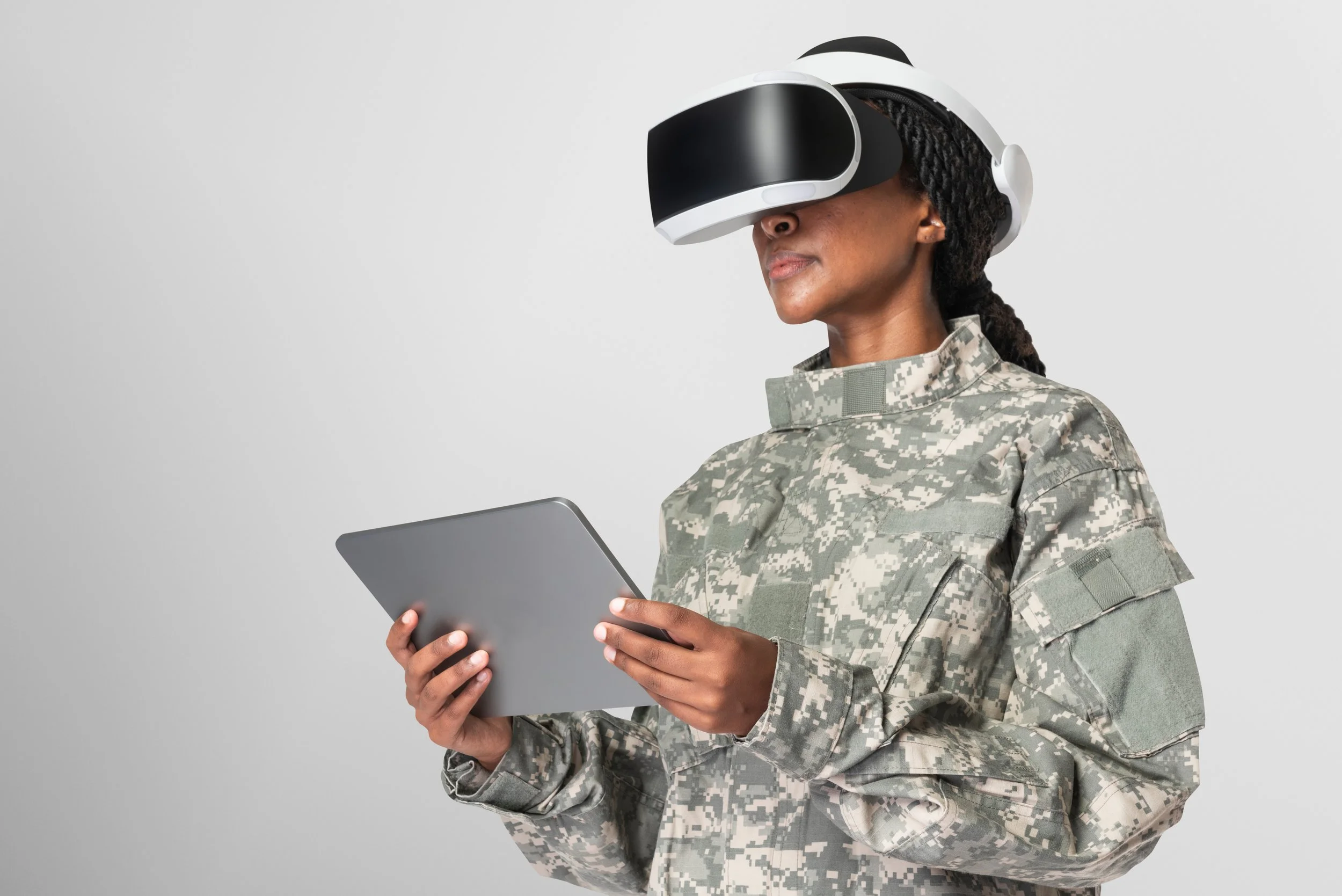
We work with partner technologies in immersive and scenario-based training and structured capture of performance data during training. We combine these with applied AI for content and scenario generation, adaptive instruction, automated assessment, and synthetic role players. Our role is to align the technology to a specific training problem, build it into a solution instructors and trainees can use, and define how proficiency will be measured so the customer can see that it worked.
Measurement is non-negotiable. Immersive technology is easy to demonstrate and hard to justify without evidence, so we design toward proficiency data tied to defined standards, useful for after-action review, instructor decisions, and readiness reporting. Applicable areas include initial qualification and recurring certification, technical and maintenance training, tactical and procedural skill development, mission rehearsal, and instructor support tools.
-
Lightweight digital environments that team with operators to simulate, test, and speed decisions.
We develop advanced digital twin and human-machine decision support solutions that help federal agencies model complex environments, evaluate operational alternatives, and make faster, more informed decisions. By integrating real-world data, physics-based modeling, AI, simulation, and intuitive visualization, we create dynamic digital representations of physical assets, systems, processes, personnel, and mission environments. These capabilities provide decision-makers with a continuously evolving operational picture that supports planning, testing, training, sustainment, and mission execution.
Our digital twin solutions connect data from sensors, enterprise systems, mission platforms, and external sources to replicate the condition, behavior, and performance of real-world systems. Agencies can use these virtual environments to monitor asset health, identify emerging risks, forecast system performance, optimize maintenance schedules, and evaluate proposed changes before implementing them in the field. From individual equipment and facilities to distributed networks and complex systems of systems, our solutions improve visibility across the operational lifecycle while reducing cost, downtime, and technical risk.
We pair digital twins with human-machine decision support tools that transform large volumes of complex data into clear, actionable insights. AI/ML, predictive analytics, and optimization models help operators identify patterns, assess competing courses of action, and understand the potential consequences of each decision. Rather than replacing human judgment, our solutions are designed to strengthen it by presenting relevant information at the right time, explaining recommendations, highlighting uncertainty, and keeping authorized personnel in control of critical decisions.
Our capabilities support scenario planning, mission rehearsal, predictive maintenance, logistics optimization, workforce readiness, command-and-control operations, infrastructure management, and acquisition analysis. Interactive dashboards, immersive visualizations, and role-based interfaces allow users to explore system behavior, test assumptions, simulate disruptions, and compare alternatives within a secure and repeatable environment. These tools can also support collaborative decision-making by providing stakeholders with a shared operating model and a common understanding of mission conditions, dependencies, and risks.
We apply modular, interoperable, and open-architecture principles to integrate digital twin and decision support capabilities with existing government platforms, data environments, and mission systems. Our approach emphasizes data governance, cybersecurity, model validation, explainable AI, and responsible human oversight. By combining trusted models with mission-relevant data and user-centered design, we help federal organizations improve situational awareness, accelerate decision cycles, enhance system resilience, and achieve better outcomes across operational, training, acquisition, and sustainment missions.
-
Explainable, auditable image recognition and matching for security, ISR support, and inspection workflows.
Operational image problems are seldom open-ended analysis problems. They are matching problems. Has this object appeared before? Is this vessel the one we’re tracking? Has this site changed since the last look? These questions arrive in volume, they consume analyst and operator time, and they are well suited to automation if the answer can be trusted.
Our focus is that class of problem, and specifically on approaches where the system can show its work. We partner with technology that performs deterministic image matching and visual recognition, meaning a user can see why a match was made and audit the result, rather than accepting an opaque score from a model that cannot explain itself. That property matters most where the answer supports a decision someone has to defend, in security, inspection, monitoring, and ISR workflows.
Our role is to take these capabilities and build them into something a specific customer can use. That means understanding the tactical environment the tool has to fit, designing interfaces around how the operator or analyst actually works, and integrating with the data environments and systems already in place.
Applicable mission sets include force protection and installation security, port and border monitoring, infrastructure and facility monitoring, maintenance and equipment inspection, change detection, and ISR-adjacent workflows where operators need to find recurring visual patterns across large image and video sets.
-
Enabling single-operator control of multiple uncrewed systems across multiple warfare domains.
The constraint on uncrewed operations is increasingly the operator, not the platform. As the number of systems in a mission grows, the workload of controlling them, interpreting what they see, and deciding what to do next grows faster than the number of people available to do it. Our focus is the layer between the operator and the systems: the autonomy, interfaces, and decision support that let one person direct many uncrewed assets without being overwhelmed by them.
We work through partner technologies in autonomous coordination and swarm control, explainable visual recognition applied to sensor and imagery feeds, and simulation environments for developing and rehearsing uncrewed operations. Our role is to align these technologies to a specific mission problem, integrate them into a solution the customer can actually use, and advance through prototype, evaluation, and transition.
Preparing people to work alongside these systems is inseparable from fielding them. Our family of companies has extensive experience delivering aircrew and operator training for federal customers, including instructional design, courseware, simulation-based instruction, and performance assessment. We apply that experience to uncrewed operations, developing the concepts of operation, operator interfaces, training, and proficiency measurement that determine whether a capability performs under real conditions or only in a demonstration.
In counter-UAS, our interest is detection, identification, and operator decision support: helping the person responsible for an airspace understand what is there, assess the risk, and act within their authorities.

CONTRACT VEHICLES
AND CERTIFICATIONS
CYBERSECURITY MATURITY MODEL CERTIFICATION - LEVEL 2
Cybersecurity Maturity Model Certification (CMMC) Level 2 demonstrates an organization’s ability to implement robust cybersecurity practices designed to safeguard Controlled Unclassified Information (CUI). Built around the security requirements of NIST SP 800-171, Level 2 emphasizes comprehensive protection, continuous compliance, risk management, and accountability across information systems. Achieving this level reflects a strong commitment to protecting sensitive government information and supporting the cybersecurity needs of the Department of Defense and its mission partners.
READY TO CONTRACt?
Let us know how our industry-leading Emerging Tech capabilities can help drive your mission forward.